
Most small businesses don’t lose customers because they’re bad at what they do. They lose them because a call didn’t get returned, a quote went cold, or a regular slipped away without anyone noticing.
A CRM (customer relationship management system) is there to stop that happening. It’s one place to keep everyone you deal with, what you’ve said to them, and what needs to happen next.
What a CRM does for a business
The benefits look a little different depending on what you do, but a few apply to almost everyone.
- Everything in safely stored in one place. Contact details, notes, emails and texts sit on one record, instead of across phones, inboxes and notebooks. Essential for if you’ve got larger teams needing to share data.
- Tasks and reminders mean the next step doesn’t rely on someone remembering it on a busy Friday.
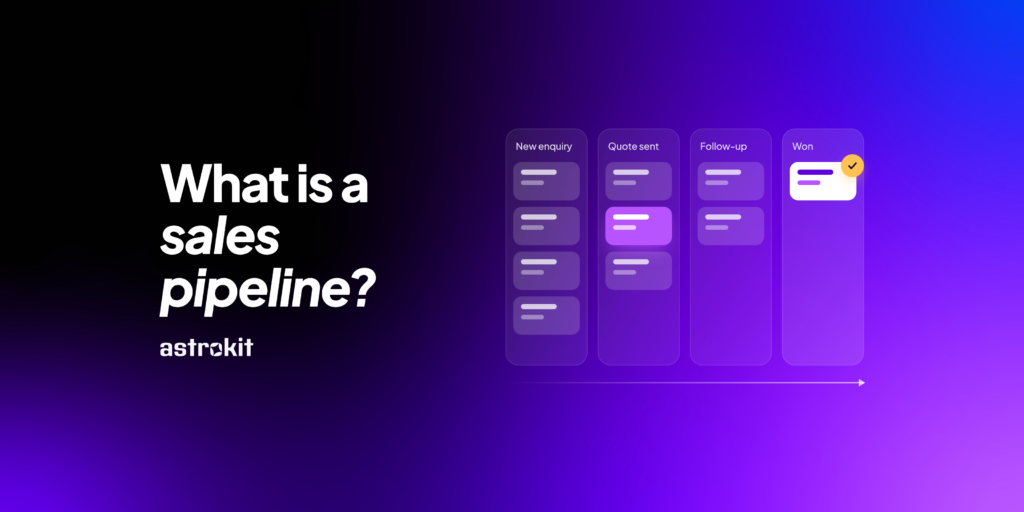
- A pipeline shows every enquiry, quote or deal and where it’s up to, so you can see at a glance where to spend your time and everything’s much clearer.
- Follow-ups and reminders can go out automatically, which frees up hours for the work you want to do instead of always being stuck in admin.
- When anyone in the team can see the full history, customers don’t have to repeat themselves. A CRM helps you deliver on great customer service.
What it costs to go without a CRM
Not having a CRM rarely shows up as one big cost. It’s a slow leak, and it’s easy to miss. An enquiry sits in an inbox for a week, and by the time you reply the customer has booked with someone who rang them back the same day. Hunting for a phone number, scrolling back through old emails or asking a colleague “did anyone reply to this?” doesn’t feel like much on its own, but it adds up over a month.
If one person holds all the customer history, a holiday, sick day or resignation can leave you starting from scratch. Without a clear view of your enquiries and quotes, you won’t know whether next month will be busy or quiet until it arrives. And when customer details are spread across spreadsheets and phones, they’re harder to keep accurate and harder to look after properly under GDPR.
A good way to work out the real cost for your business is to count the enquiries you had last month, then ask how many you can honestly say were followed up properly. Where there any who had said they had already made arrangements with a competitor? This is the enquiry gap that’s costing you money every month, and a CRM can help you recover that revenue going forward.
How a CRM helps different types of business
The basics are the same for everyone. What changes is which problems a CRM solves first. Here’s how it plays out in four very different businesses.
Hairdressers and salons
A salon lives on regulars. The trouble is that what makes a regular feel looked after is usually stored in a stylist’s memory.
- Client notes that travel with the client: Colour formulas, preferred styles, sensitive scalps and the date of their last patch test can all sit on their record. If their usual stylist is off, whoever picks up the scissors still knows exactly what to do.
- Fewer empty chairs: A quick text reminder the day before cuts down on no-shows, and a gap in the diary costs a salon far more than the price of a message.
- Spotting who’s drifted away: If someone who came in every six weeks hasn’t been seen for three months, a CRM makes that easy to notice. A friendly “we’ve missed you” message is often all it takes to win them back.
- Knowing what sells: Notes on which treatments and products each client buys help you suggest the right thing, rather than giving everyone the same pitch.
With Astrokit CRM, you can add your own custom fields for things like colour formulas or patch test dates.
Tradespeople
If you’re a plumber, electrician or builder, enquiries tend to arrive while your hands are full. A missed call on a Tuesday morning can easily turn into a forgotten job by Thursday.
- Chasing quotes without the awkwardness: Plenty of quotes go unanswered simply because the customer got busy. A CRM shows every quote you’ve sent and how long it’s been sitting there, so a polite nudge goes out while the job is still up for grabs.
- Seeing your work lined up: Stages like enquiry, site visit, quote sent, booked and finished give you a picture of the coming weeks. It’s much easier to decide whether to take on that extra job when you can see what’s already in the diary.
- A history for every property: What you fitted, when, and what you noticed while you were there. When the customer rings two years later, you’re not starting from scratch, and you can mention the boiler service that’s now due.
- Turning finished jobs into the next ones: Most trades rely on word of mouth. Logging when a job’s done makes it easy to ask for a review or a referral while the customer is still pleased with the work.
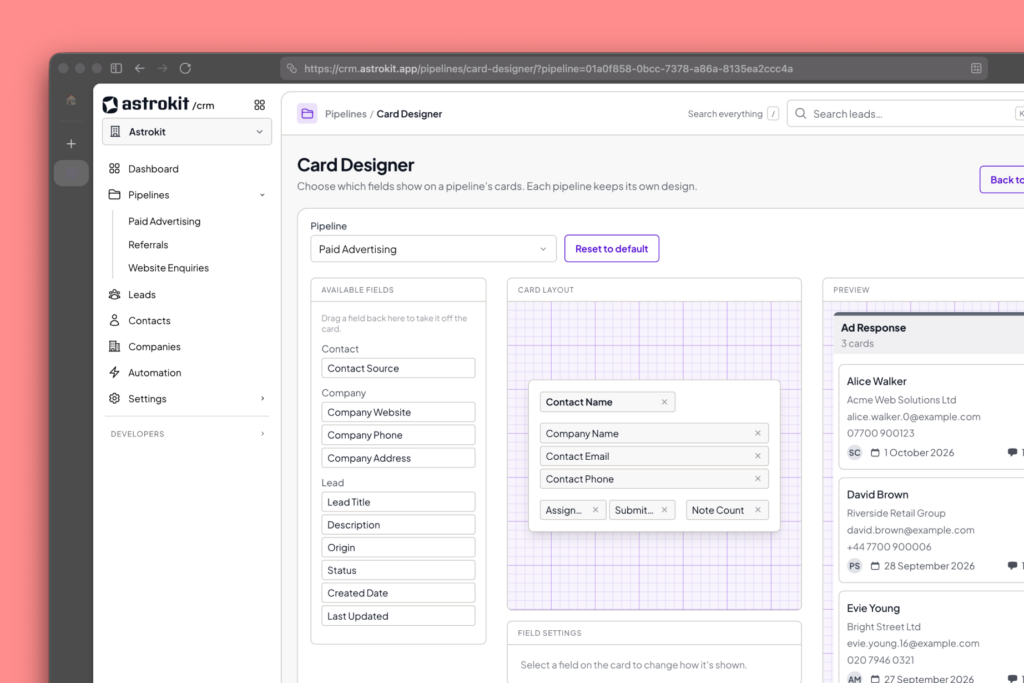
Astrokit CRM lets you name your own pipeline stages, so they match how you actually work rather than a sales team’s process. A follow-up email can go out automatically when a quote moves to a new stage, all easily managed from your phone while you’re busy at work.
Marketing agencies
Agencies spend their days generating leads for other people, then often let their own new business run on a shared spreadsheet and good intentions.
- New business and existing clients, kept apart: Pitches and proposals need one set of stages. Onboarding a signed client needs another. Running both in separate pipelines stops a hot prospect getting lost among setup tasks.
- Knowing where your best clients come from: Was it a referral, a LinkedIn post, or that awards entry? Recording where each lead came from shows you which efforts bring in clients worth having, not just the most enquiries.
- Smooth handovers: Account managers change. When every call, email and decision is on one timeline, the new person can pick up the relationship without asking the client to explain it all again helping to smooth that transition.
- Getting ahead of renewals: Retainers and project end dates are the moments clients quietly review their options. A dated task on the account gives you time to show results and talk about what’s next, before someone else does.
Astrokit CRM supports multiple pipelines for different lines of work, and you can assign leads to people in the team. Calls, meetings, notes and emails from everyone land on one timestamped timeline for each contact and deal.
Professional Services
With this type of business clarity, communication and attention to detail are essential. Let’s take an Accountant as an example, here’s how a CRM can help this type of business never miss a deadline and grow.
- Chasing paperwork earlier: Most deadline stress comes from clients sending records late. Tracking who has sent what, and who hasn’t, lets you start chasing in good time instead of the week before.
- A tidy onboarding process: Taking on a new client involves the same steps every time: engagement letter, ID checks, getting authority to act and collecting records. Treating these as pipeline stages shows exactly where each new client is stuck.
- Spotting the right extra service: A sole trader whose turnover is climbing may soon need VAT registration, or help with payroll once they take someone on. Notes on each client make those conversations easy to time well.
- Looking after sensitive information: Accountants hold some of the most personal data a client has. Keeping it in one secure system is far safer than scattered spreadsheets and email attachments.
Astrokit CRM lets you add fields for the dates that matter to each client, like year end or VAT quarter, and overdue tasks are shown clearly rather than buried. Data is stored and processed in UK and EU regions under UK GDPR, and built-in tools let you anonymise someone’s details with an audit trail if they ask. Whether you’re an Accountant or a Solicitor a CRM can make your day to day management so simple.
Finding a CRM that fits your business
You’ll notice a pattern in the examples above. A salon, a plumber and an accountant all need a CRM, but they need it to work in very different ways. That’s where a lot of small businesses get stuck. Many CRMs are built for big sales teams, then cut down for everyone else, and you end up paying for features you’ll never touch.
Astrokit CRM was built for UK small and mid-sized businesses from the start. It’s simple, with no extra fluff: contacts, pipelines, follow-ups and a clear history of every conversation, which are the things you’ll use every week, without the clutter. It’s also shaped around how you work. You can name your own stages, add your own fields and run separate pipelines for different parts of the business, so a hairdresser’s CRM and an accountant’s can look completely different. When you need help, it comes from people in the UK that know how UK businesses run.
If you’re curious about how CRM can help your business grow you can join our waitlist to be notified when Astrokit CRM launches or contact us today if you’d like to know more about Astrokit and our roadmap.